

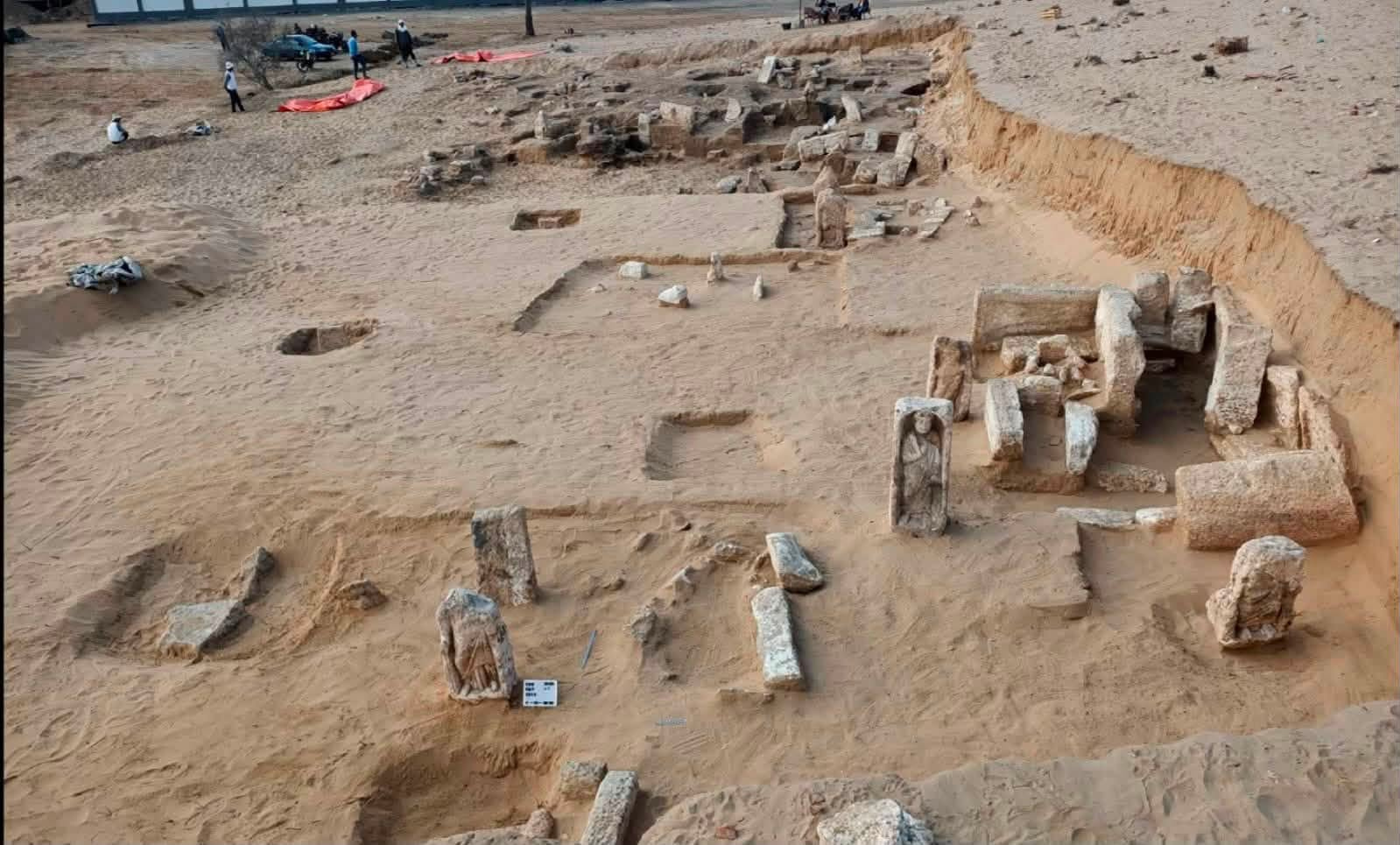
Today in Egypt there is a new discovery was announced by the supreme council of antiquities, around 240 km to the north of Cairo, in Damietta which lies on the Mediterranean was the place of this discovery.
– The discovery confirms that the Tel al-Deir area was a comprehensive funerary center reflecting a clearly defined social, cultural, and religious identity.
The Egyptian archaeological mission affiliated with the Supreme Council of Antiquities has uncovered a number of tombstones, coffins, and ancient amulets in the Tel al-Deir area of Damietta Governorate during its current excavation season at the site.
Dr. Hisham Al-Leithi, Secretary-General of the Supreme Council of Antiquities, explained that the Council is committed to providing full support to the Egyptian mission during its work at the site, in accordance with the directives of Mr. Sherif Fathy, Minister of Tourism and Antiquities, to facilitate the work of various archaeological missions at Egyptian sites.
The Secretary-General of the Supreme Council of Antiquities noted that this discovery opens new horizons for understanding the evolution of cemeteries in the Egyptian Delta and confirms that the Tell al-Deir area was not merely a burial site, but rather a comprehensive funerary center reflecting a clearly defined social, cultural, and religious identity. The discovery also reinforces the site’s archaeological significance as one of the most prominent archaeological sites in the eastern Delta; with its layers and archaeological evidence, it has the potential to redraw the map of ancient settlements and cemeteries and to reinterpret the history of Damietta Governorate in ancient times.
For his part, Professor Mohamed Abdel-Badei, Head of the Egyptian Antiquities Sector at the Supreme Council of Antiquities, stated that the discovered tombstones number approximately twenty unique limestone tombstones, carved with great care and featuring human figures rendered in a highly refined artistic style, while their sides and fronts were adorned with a collection of symbols and deities with religious significance, including the griffin, Agathadimon, and Isis Thermotis—iconic elements that reflect a remarkable civilizational and cultural interaction between the Egyptian religious heritage and Greco-Roman influences, and also point to the distinguished social status of the owners of these tombstones.
He added that the expedition also uncovered a large and diverse collection of ceramic incense burners and ornate lamps of various shapes, along with barrel-shaped anthropomorphic ceramic coffins, as well as a number of funerary amulets. These discoveries provide a more complete picture of the ritual and symbolic practices associated with burial customs across different historical periods, and they reflect a continuous evolution that confirms that the Tell al-Deir area represents an extensive cultural zone spanning from the Late Period through the end of the Roman Period, making it a living archaeological record of the transformations in the social, religious, and funerary landscape of the Nile Delta over many centuries of history.
1 comment
great news ….