

New great discovery near to suez canal close to port said governorate.
For the first time… A comprehensive complex of bathing facilities was discovered at the Tell Nasser site in Port Said
• The discovery provides new insights into the history of settlement and the development of architecture and public services in the Eastern Delta during the Ptolemaic and Roman periods
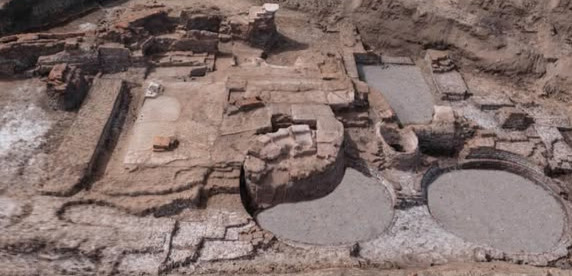
The archaeological mission affiliated with the Supreme Council of Antiquities has, for the first time, uncovered a comprehensive complex of bathing facilities at the Tell Nasser site in the Port Said archaeological zone.
The discovery was made during the first excavation season in the area, which is situated approximately 40 km south of the city of Port Said and 35 km north of the city of Al-Qantara West, and 1.5 km north of the Al-Salam Canal.
Mr Sherif Fathy, Minister of Tourism and Antiquities, praised the important archaeological and scientific findings resulting from the mission’s work, emphasising that the discovery represents a new contribution to our understanding of the history of settlement and the development of architecture and public services in the Eastern Delta during the Ptolemaic and Roman periods, and reflects the wealth of promising archaeological features in the Port Said archaeological area, which merit further research and study.
For his part, Dr Hisham El-Leithy, Secretary-General of the Supreme Council of Antiquities, explained that the results of the preliminary study of the archaeological strata and the finds revealed successive phases of settlement at the site, beginning with a layer dating from a period prior to the Ptolemaic era, specifically the late 4th and early 3rd centuries BC, represented by Cypriot pottery traditions and Greek amphorae, confirming the existence of an early settlement predating the construction of the bath complex. He noted that the subsequent strata indicate the Ptolemaic settlement phase during the second and first centuries BC, represented by a collection of Rhodian amphora stamps and other local and imported pottery.
He emphasised that the significance of this discovery lies in the documentation of the first complete bath complex to be scientifically uncovered at the Tell Nasser site, and in proving the existence of settlement at the site prior to the Ptolemaic period, as well as documenting the continued use of the complex with architectural modifications during the Roman period, reflecting the continuity of its importance and function. The discovery also provides a comprehensive model of hydraulic engineering in the Eastern Delta and highlights similarities with the Hellenistic baths known in Egypt, including the recently discovered bathhouse at Tell al-Hayr in North Sinai, whilst the Tell Nasser complex is distinguished by the presence of a private bathing unit alongside the public bathhouse and an integrated water supply and drainage system.
Professor Mohamed Abdel-Badei explained that the discovered complex consists of a private bathing unit and a public one, in addition to an integrated water supply and drainage system. The private bathing unit comprises a circular basin approximately 2.5 metres in diameter, built of red brick with walls coated in pink, moisture-proof mortar, alongside two oval-shaped foot baths, a drainage network comprising longitudinal channels, and a low-lying structure believed to be associated with water heating.
He emphasised that the significance of this discovery lies in the documentation of the first complete bath complex to be scientifically uncovered at the Tell Nasser site, and in proving the existence of settlement at the site prior to the Ptolemaic period, as well as documenting the continued use of the complex with architectural modifications during the Roman period, reflecting the continuity of its importance and function. The discovery also provides a comprehensive model of hydraulic engineering in the Eastern Delta and highlights similarities with the Hellenistic baths known in Egypt, including the recently discovered bathhouse at Tell al-Hayr in North Sinai, whilst the Tell Nasser complex is distinguished by the presence of a private bathing unit alongside the public bathhouse and an integrated water supply and drainage system.
He added that the bath complex is thought to have been built in the late first century BC, and continued to be used throughout the Roman period, with architectural evidence revealing a number of alterations to its structures whilst retaining its primary function as a bathing facility until the second century AD, a fact confirmed by the pottery finds, particularly lamps, tableware and plates. Archaeological evidence also shows that, in a later phase of the Late Roman period, parts of the complex were reused for storage purposes, as indicated by the Gaza amphorae found at the site.
He added that the public baths consist of two circular rooms (tholos), each with a diameter of around five metres; the first room contains five foot-bath units, three of which remain in a good state of preservation, Each unit features a backrest, side armrests and a circular recess for the feet, as well as three rectangular basins, a quarter-circular basin for collecting and distributing water, a floor made of non-slip hydraulic mortar, and a drainage outlet connected to the internal drainage system.
For his part, Mr Khaled Farid, Director of the Port Said Antiquities Region and head of the mission, noted that the excavations also revealed an integrated hydraulic system comprising a main water supply channel made of red brick, approximately 6 metres in length, raised above ground level to protect the water during transport, part of which is covered by a red-brick vaulted ceiling, alongside an integrated drainage network and an extension of a red-brick wall running beneath the channel. An older channel was also uncovered beneath the current supply channel, along with the remains of residential walls beneath the fill, confirming the existence of earlier construction phases at the site.
He added that the excavations also yielded a distinguished collection of archaeological finds, including Rhodian amphora seals bearing Greek names, local and imported amphorae, cups and jugs, earthenware lamps from the Ptolemaic and Roman periods, and plates and tableware, which have helped to date the site’s strata and identify the phases of settlement there.